Unplanned Explosions at Munitions Sites
Posted 26 March 2013
Unplanned explosions at munitions sites (UEMS) are a global problem.
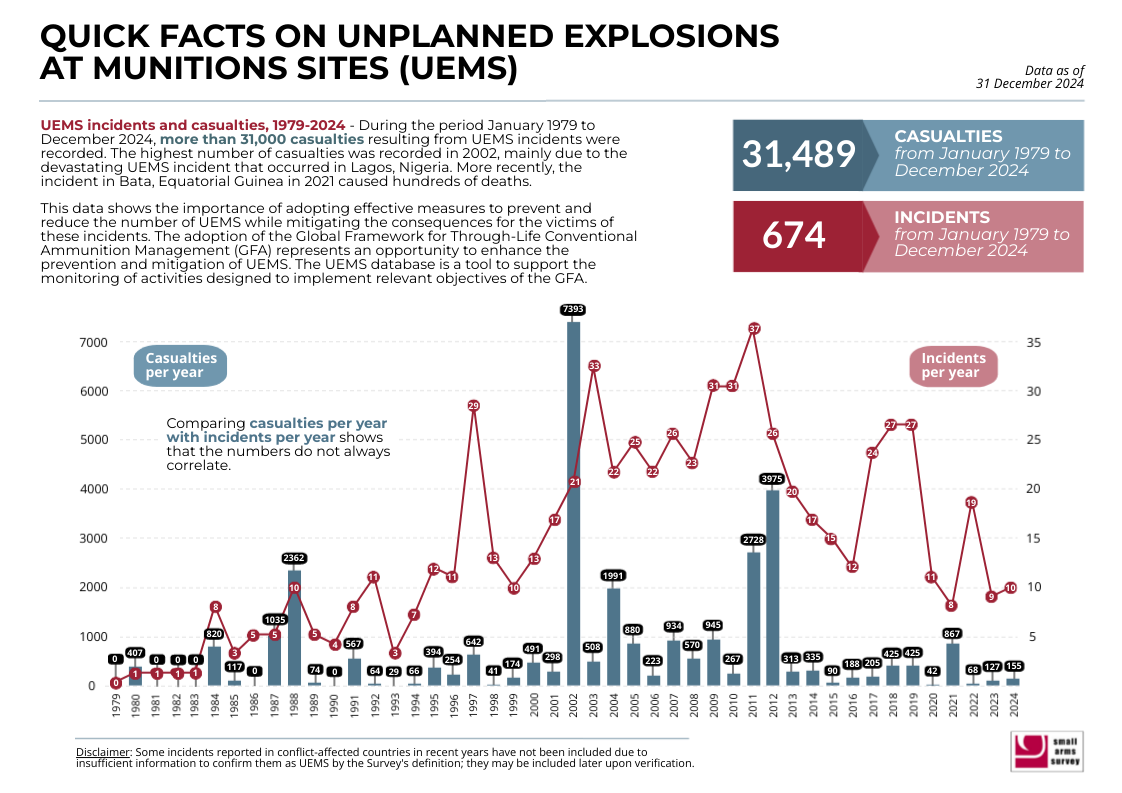
The Small Arms Survey has produced an historical overview of every known UEMS event dating back to 1987. To date, 453 incidents of this nature have been recorded in 92 countries, affecting almost half of UN member states, and covering every continent except Antarctica and Australia (see Table 1).
An examination of the historical trends reveals that the frequency of UEMS incidents has risen dramatically over the past 26 years. Analysis of ten-year averages illustrates this steady increase in the number of incidents. An average of seven incidents per year was recorded for the first ten years of the UEMS records (1987-1996). This rose to over 20 per year during the next ten years (1997-2006) and then to 35 per year over the last six years (2007-2012). (For a detailed breakdown of events by year, see the tables on the UEMS Incidents by Year page.) Certainly some of this increase in frequency is explained by an increase in global reporting and media coverage. However, the dramatic increase in incidents over the past 26 years does signal that the number of explosions is not decreasing, despite efforts to address their causes (see Publications below).
The UEMS database remains an on-going Small Arms Survey project. New incidents are continuously recorded, and are periodically added to these pages. Nine new events were identified and recorded during the last quarter of 2012. Data is also retroactively added or amended as new, credible information is uncovered. Over the past six months, 19 previously unknown accidents were discovered largely thanks to the cooperation of several Survey partners.
- Detailed tables on UEMS Incidents by Year
- Definition of unplanned explosions at munitions sites (UEMS)
- For more information, see Research Note 6: Unplanned Explosions at Munitions Sites (now also available in Albanian, BCMS, Bulgarian, Macedonian, Romanian, and Slovenian).
Table 1
*Small Arms Survey (Forthcoming).
Figure Number of Recorded UEMS by Year, January 1987—December 2012
Table 2
Definition
Unplanned Explosions at Munitions Sites (UEMS) include accidents1 resulting in the explosion2 of abandoned3, damaged4, improperly stored5, or properly stored stockpiles of munitions6 and explosives. For our purposes, munitions sites comprise storage areas7 (including those temporarily maintained during demilitarization or explosive ordnance disposal) and processing sites,8 whether temporary or permanent. Ammunition manufacturing facilities (ordnance factories) are not included, but accidents during ammunition processing operations within munitions sites have been included where known.
1. An accident is defined as: ‘an undesired event, which results in harm’ (UNODA, 2011, para. 3.5, p.2). ‘Harm’ is defined as: ‘physical injury or damage to the health of people, or damage to property or the environment’ (UNODA, 2011, para. 3.120, p. 14).
2. An explosion is defined as: ‘a sudden release of energy producing a blast effect with the possible projection of fragments. The term explosion encompasses fast combustion, deflagration and detonation’ (UNODA, 2011, para. 3.95, p.11).
3. Abandoned Explosive Ordnance (AXO) is defined as: ‘explosive ordnance that has not been used during an armed conflict, that has been left behind or dumped by a party to an armed conflict, and which is no longer under control of the party that left it behind or dumped it. Abandoned explosive ordnance may or may not have been primed, fuzed, armed or otherwise prepared for use’ (UNODA, 2011, para. 3.1, p.1).
4. Damaged munitions refer to the physical or chemical deterioration of ammunition and explosives.
5. Munitions are considered improperly stored when storage does not generally follow accepted multilateral norms or guidelines, or existing national legislation and controls.
6. Munitions is used in this definition—and in common usage—to refer to weapons, ammunition, explosives and components. A number of armed forces and ammunition specialists, however, use the term munitions to refer solely to complete rounds of ammunition (cf. Ammunition) (Bevan and Wilkinson, 2008, p. xxvi). Ammunition: A complete device (e.g. missile, shell, mine, demolition store, etc.) charged with explosives; propellants; pyrotechnics; initiating composition; or nuclear, biological, or chemical material for use in connection with offence, or defence, or training, or non-operational purposes, including those parts of weapons systems containing explosives (cf. Munition) (Bevan and Wilkinson, 2008, p. xix).
7. An Explosive Storage Area (ESA) is defined as: ‘an area used for the storage of explosives and within which authorised ammunition or missile preparation, inspection and rectification operations may also be carried out’ (UNODA, 2011, para. 3.108, p.12).
8. An ammunition process [site] is defined as: ‘a building or area that contains or is intended to contain one or more of the following activities: maintenance, preparation, inspection, breakdown, renovation, test or repair of ammunition and explosives’ (UNODA, 2011, para. 3.12, p.2).
This page will be routinely updated. For additional information and to report incidents not listed, please contact Small Arms Survey Researcher Benjamin King:
benjamin.king@
smallarmssurvey.org
References
Bevan, James and Adrian Wilkinson. 2008. ‘Glossary of Conventional Ammunition Terminology.’ In James Bevan, ed. Conventional Ammunition in Surplus: A Reference Guide. Geneva: Small Arms Survey, pp. xix–xxxiii.
Small Arms Survey. Forthcoming. ‘Unplanned Explosions at Munitions Sites database’. Geneva: Small Arms Survey.
UNODA (United Nations Office for Disarmament Affairs). 2011. ‘International Ammunition Technical Guidelines: Glossary of terms, definitions and abbreviations.’ (ATG 01.40). First edition. New York: UNODA. October.
Wilkinson, Adrian. 2011. ‘The threat from explosive events in ammunition storage areas’. Edition No. 2, May. Kent: Explosive Capabilities Limited.
Zahaczewsky, George. 2011. ‘Major Ammunition Accidents – Compilation of events from 1917 to 2011’. Unpublished document.
Small Arms Survey Publications
-
Costs and Consequences: Unplanned Explosions and Demilitarization
in South-east Europe, by Jasna Lazarević, a joint publication of the Regional Approach for Stockpile Reduction, the US Department of State's Office of Weapons Removal and Abatement, and the Small Arms Survey, November 2012. Special Report No. 18
Download (1.82 MB)
-
Blue Skies and Dark Clouds: Kazakhstan and Small Arms, by Nicolas Florquin, Dauren Aben, and Takhmina Karimova, May 2012. Occasional Paper No. 29 (also available in Kazakh and Russian; Executive Summary available in English, Kazakh, and Russian)
Download (1.23 MB)
-
Significant Surpluses: Weapons and Ammunition Stockpiles in South-east Europe, by Pierre Gobinet, a joint publication of the Regional Approach for Stockpile Reduction, the US Department of State’s Office of Weapons Removal and Abatement, and the Small Arms Survey, December 2011. Special Report No. 13
Download (2.25 MB)
-
Unplanned Explosions at Munitions Sites, May 2011, updated January 2012. Research Note No. 6, Weapons and Markets (also available in Albanian, BCMS, Bulgarian, Macedonian, Romanian, and Slovenian). (Updated information available)
Download (463.91 KB)
-
Safer Stockpiles: Practitioners’ Experiences with Physical Security and Stockpile Management (PSSM) Assistance Programmes, edited by Benjamin King, April 2011. Occasional Paper No. 27
Download (965.63 KB)
-
Scraping the Barrel: The Trade in Surplus Ammunition, April 2011. Issue Brief No. 2
Download (1.6 MB)
-
Surplus Arms in South America: A Survey, by Aaron Karp, a study by the Small Arms Survey in cooperation with the Conflict Analysis Resource Center (CERAC), August 2009. Working Paper No. 7 (also available in Spanish and Portuguese)
Download (433.14 KB)
-
The Politics of Destroying Surplus Small Arms - Inconspicuous Disarmament, edited by Aaron Karp, published by Routledge, July 2009.
More information
-
A Semi-automatic Process? Identifying and Destroying Military Surplus, by Aaron Karp, 2008. In Small Arms Survey, Small Arms Survey 2008: Risk and Resilience.
Download (4.74 MB)
-
Ammunition Depot Explosions, by Adrian Wilkinson, 2008. In James Bevan, ed. Conventional Ammunition in Surplus: A Reference Guide, co-published with BICC, FAS, GRIP, and SEESAC with support from the German Federal Foreign Office.
Download (108.83 KB)
-
Conventional Ammunition in Surplus: A Reference Guide, edited by James Bevan, co-published with BICC, FAS, GRIP, and SEESAC with support from the German Federal Foreign Office, January 2008.
More information
-
Red Flags and Buicks: Global Firearms Stockpiles. In Small Arms Survey, Small Arms Survey 2002: Counting the Human Cost.
Download (2.17 MB)
Other Publications
-
Berman, Eric and Pilar Reina. 2012. 'Unplanned Explosions at Munitions Sites: Concerns and Consequences', in The Journal of ERW and Mine Action. Issue 16.2, July.
More information
-
United States Department of State, Bureau of Political–Military Affairs. 2012. Dangerous Depots: The Growing Humanitarian Problem Posed by Aging and Poorly Maintained Munitions Storage Sites. Washington: US Department of State.
More information
-
Berman, Eric G., Pierre Gobinet and Pilar Reina. 2011. Dangerous Stockpiles: Unplanned Explosions' High Costs, in NATO Review.
More information
-
North Atlantic Treaty Organization (NATO). 2010. Manual of NATO Safety Principles for the Storage of Military Ammunition and Explosives. Brussels: NATO.
Download
-
South Eastern and Eastern Europe Clearinghouse for the Control of Small Arms and Light Weapons (SEESAC). 2007. Ammunition and Explosives Storage and Safety. RMDS/G 05.40, 5th edn. Belgrade: SEESAC.
Download
-
Regional Centre on Small Arms and Light Weapons (RECSA). 2005. Best Practice Guidelines for the Implementation of the Nairobi Declaration and the Nairobi Protocol on Small Arms and Light Weapons. Nairobi: RECSA
Download
Further Resources
- CASA (United Nations Coordinating Action on Small Arms): CASA Project on International Small Arms Control Standards (ISACS).
- NATO MSIAC (Munitions Safety Information Analysis Center): NATO MSIAC Quarterly Newsletter.
- OSCE (Organization for Security and Co-operation in Europe): Handbook of Best Practices on Conventional Ammunition
- UNODA (United Nations Office for Disarmament Affairs): International Ammunition Technical Guidelines.