The full-scale Russian invasion has left Ukraine facing numerous security and governance challenges, many of which are linked to the widespread circulation of small arms and light weapons. Since 2022, Ukrainian authorities have seized tens of thousands of firearms, grenades, and explosives, yet large stockpiles remain unaccounted for. The growing prevalence of illicit arms is already contributing to rising levels of crime and gender-based violence and, if left unaddressed, risks fuelling regional insecurity through potential cross-border trafficking. Mitigating these threats is therefore central to Ukraine’s recovery and to European and international security.
Building on a decade of field research and collaboration with Ukrainian stakeholders, the project will deliver measurable improvements in Ukraine’s capacity to prevent and respond to illicit arms proliferation.
Specifically, the project will:
- Increase the amount of actionable, open-source intelligence and analysis on illicit arms and ammunition and combat disinformation by compiling and analysing hitherto under-utilized data on seized and trafficked weapons.
- Enhance institutional capacities to prevent illicit arms proliferation and armed violence at the national and local levels by strengthening capacities in designing and implementing effective and gender responsive counter-proliferation and armed violence prevention policies and initiatives, in coordination with regional and multilateral initiatives.
- Facilitate multi-stakeholder policy dialogue on post-conflict weapons-related challenges by convening informed consultations and workshops that bring together state institutions, civil society, academia and private sector.
Highlights
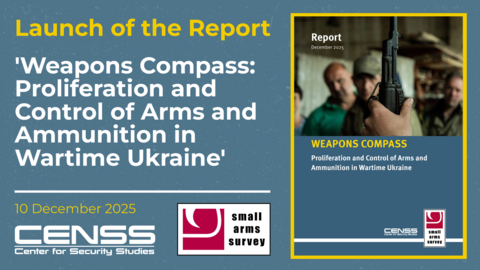
- 10 December 2025 - Launch of the Report 'Weapons Compass: Proliferation and Control of Arms and Ammunition in Wartime Ukraine' (webinar video)
- 28 August, 2025 - Final meeting of the Ukrainian Networking Group within the framework of the 'Supporting Ukraine in addressing the risks of small arms and light weapons proliferation from the Russian war of aggression' project
- 4 June, 2025 - News from CENSS: Gun culture as a challenge for society: a roundtable discussion was held in Khmelnytskyi based on the results of an essay competition (in Ukrainian)
- 10-11 May, 2025 - News from CENSS: Student forum on constitutional law: dialogue on security, democracy and the future of the state
- 17 March, 2025 - News from the UNG: Presentation of research on criminal proceedings under Article 263 of the Criminal Code of Ukraine
- 6 December, 2024 - Annual conference of the Supporting Ukraine in Addressing Small Arms and Light Weapons Proliferation Risks from the Russian War of Aggression project
- 12 September, 2024 - Coordination and progress meetings in Kyiv
- 5 June, 2024 - News from CENSS: Training on the trafficking and possession of weapons in the EU and Ukraine for the project’s professional community
- 29 May, 2024 - Work from the UNG: A public service video campaign from IKAR
- 29 April, 2024 - News from CENSS: 'We are starting to introduce you to our security projects'
- 7 December, 2023 - News from CENSS: Webinar on the Threats of the Proliferation of Illegal 3D-Printed Weapons
- 18 October, 2023 - The Small Arms Survey and the Center for Security Studies (CENSS) joint press release on the Inception Meeting of the Ukrainian Networking Group—The Risks Of Illicit Small Arms And Light Weapons Proliferation